Biology Scholars Publish Research and Advance Patent with Faculty Mentors
Two York College biology scholars—Widnie Mentor and Sara Arain—are already making their mark in scientific research, co-authoring papers in leading peer-reviewed journals, including “Investigative Ophthalmology and Visual Science;” and “FASEB BioAdvances.”
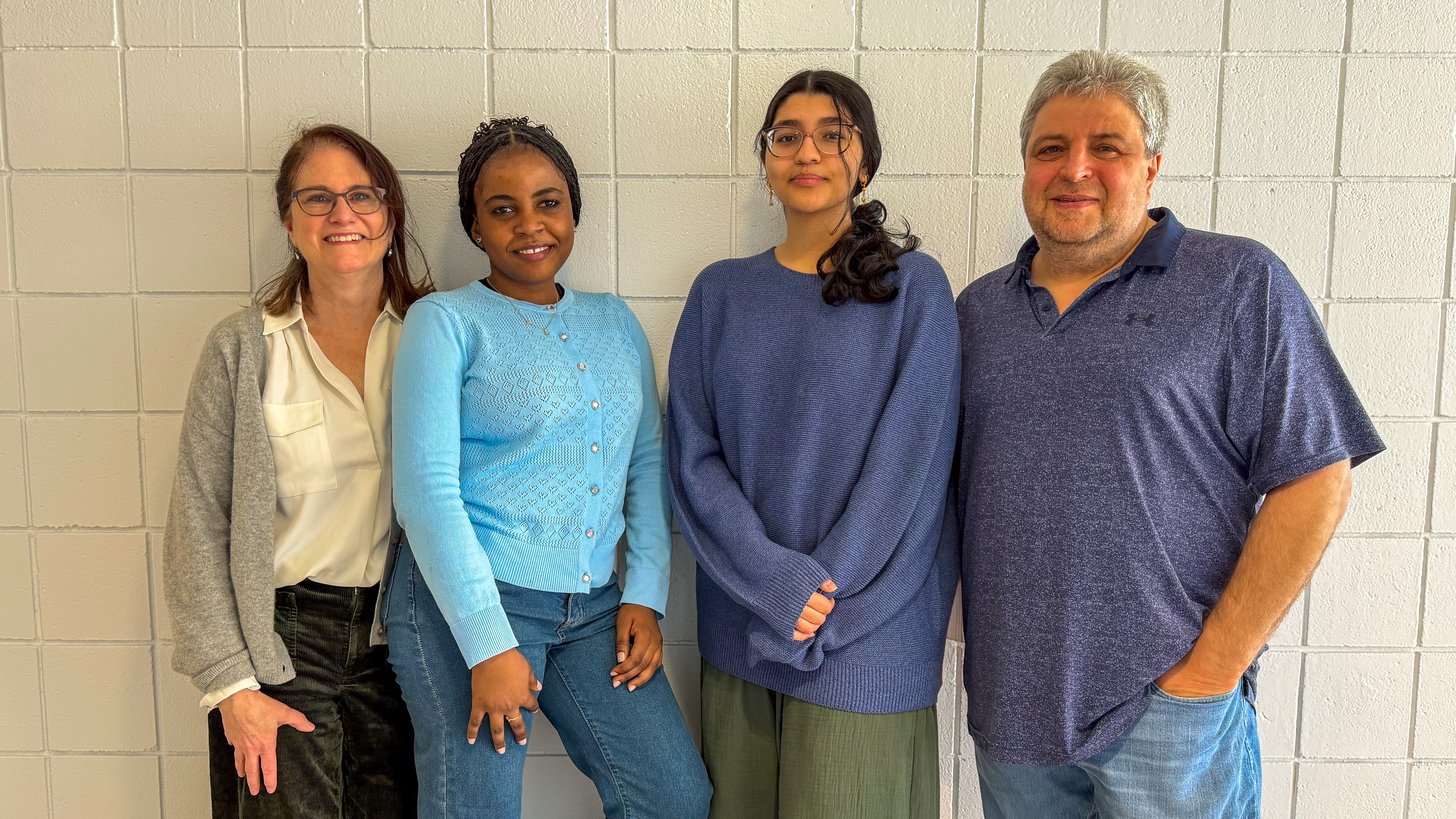
Mentor, a member of York College’s Class of 2024 and mentee of Dr. Margaret MacNeil, and Arain, a senior mentored by Dr. Alexander Birk, have collaborated closely with their professors on research that is advancing the understanding of mitochondrial protection and neurodegeneration.
Dr. MacNeil and Dr. Birk—whose research efforts have secured millions of dollars in funding to support their work—express strong confidence in the young biologists.
“Both Widnie and Sara have made real contributions to this NIH-funded work,” said Dr. MacNeil. “Widnie particularly on the transmission electron microscopy showing mitochondrial protection, and Sara on the functional analyses. They’re both exceptional researchers and represent exactly the kind of scientific training and achievement we want to highlight at York.”
Mentor, who earned her bachelor’s degree in Biology, spoke about her work since graduating.
“After graduation, I began working as a research technician in Dr. MacNeil’s laboratory, where I focus on neurodegeneration within the visual system,” she explained. “I also serve as a part-time College Laboratory Technician (CLT) in the Biology Department. My long-term goal is to pursue a PhD and build a career in neuroscience research.”
Her research focuses on protecting retinal ganglion cells (RGCs) and optic nerve axons in both acute and chronic injury models.
“Specifically, we investigate the neuroprotective effects of the mitochondria-targeted peptide HDAP2,” Mentor noted. “HDAP2 binds to cardiolipin in the inner mitochondrial membrane, maintaining mitochondrial structure and function, which is critical for cell survival under stress. I am a co-author on two publications related to this research.”
Publication highlights include:
- “Mitochondrial-Targeted HDAP2 Preserves Retinal Ganglion Cells and Increases Pressure Tolerance in DBA Mice.”
- This study examines the protective effects of HDAP2 in a chronic glaucoma model characterized by elevated intraocular pressure (IOP), demonstrating that the compound preserves retinal ganglion cells and optic nerve axons under high pressure.
- "The mitochondria-targeted peptide HDAP2 reduces mitochondrial loss and retinal ganglion cell degeneration after optic nerve injury."
This research focuses on an acute optic nerve crush model and shows that HDAP2 reduces mitochondrial loss and retinal ganglion cell death following injury.
Arain is also advancing rapidly in the field. In addition to co-authoring published papers, she, along with Dr. Birk and Dr. MacNeil, is a co-inventor on a provisional patent with RFCUNY for a novel compound that stabilizes the inner mitochondrial membrane, supports ATP production, and inhibits mitochondrial reactive oxygen species to enhance mitochondrial bioenergetics.
“We commonly reference this compound as HDAP13, or A13,” Arain explained. “It is still new, and I have been working on its applications in skin disorders that have roots in mitochondrial pathology, such as chronic wounds, inflammation, and itching. I am currently working on my first-author paper to showcase its development.”
Arain noted that the team’s current publications focus on HDAP2 (A2), while HDAP13/A13 represents “an entirely new compound.” For the past two years, the undergraduate scholar has worked in Dr. Birk’s lab on the preclinical development of mitochondria-targeted compounds. She also shared links to her work:
“The mitochondria-targeted peptide HDAP2 reduces mitochondrial loss and retinal ganglion cell degeneration after optic nerve injury.”
DOI: 10.1016/j.neuroscience.2026.01.045 “Targeting High-Density Aromatic Peptides to Cardiolipin Optimizes the Mitochondrial Membrane Potential and Inhibits Oxidative Stress.”
DOI: 10.1096/fba.2024-00061
Dr. Birk, an expert in bioenergetics and pharmacology, praised Arain’s resourcefulness and rapid development as a scientist.
“Sara has made exceptional contributions to this laboratory over the past two years, demonstrating a level of scientific maturity and intellectual independence that is uncommon even among graduate students,” he said. “She joined the lab as a freshman in February 2024 with no prior research experience, and within her first three weeks had completed a mouse toxicology study.”
Her data contributed directly to a peer-reviewed publication in which she is listed as second author.
“Her intellectual contributions have been equally significant,” Dr. Birk added. “For example, Sara discovered that our therapeutic compound stabilizes cardiolipin within mitochondrial membranes through biochemical assays -- work that shaped the direction of a second publication establishing the compound as a new class of mitochondria-stabilizing molecules.”
Arain has also proposed and independently developed a new research project investigating the topical application of mitochondria-targeted antioxidants in an inflammatory oxidative stress model. To pursue this work, she developed an animal model and multiple experimental protocols from scratch. She is also a co-inventor on the patent for this novel antioxidant alongside Dr. Birk and Dr. MacNeil.
In addition to her laboratory achievements, Arain has mentored several high school and college students and has presented her research at multiple CUNY conferences, including presentations at the CUNY Borough of Queens Undergraduate Research Consortium and the Third Annual CUNY Undergraduate Research Celebration at John Jay College.
“She is currently preparing her first first-author manuscript,” Dr. Birk said. “In just under two years, she has become an independent researcher with a rigor that is rare at any level.”
Revised: March 11, 2026
York College / CUNY
94 - 20 Guy R. Brewer Blvd.
Jamaica, NY 11451
P: 718-262-2000